Two shops on the same street can both say they "use a booking app" and be paying for completely different things. One is paying to be found. The other is paying to be booked.
Those are two products with two kinds of bill. Most of the confusion about what booking software costs comes from holding one up against the other.
A marketplace, and a site of your own
A marketplace is an app or a website where customers browse shops, and yours is one of many on it. Somebody who has never heard of you types "barber near me" and there you are, in a list with everyone else in town. Its job is to bring you people you didn't have.
A booking site of your own is your address with your name on it. Nobody wanders onto it by accident. People arrive because they already know you: from Instagram, from Google, from the card on the counter, from a friend. Its job is to let those people book without ringing you.
Who gets paid, and when
A marketplace
- Usually a monthly fee
- A cut of new customers it sends
- Nothing when they come back
- “New” is what the contract says
A site of your own
- A monthly fee
- No cut: it sent you nobody
- Same bill, busy month or quiet
- Your customers were yours already
They charge differently because they do different work. A marketplace can charge for the customers it sends you. A site of your own has sent you nobody, so there's nothing to take a cut of.
How Treatwell charges
Treatwell is a marketplace. Its partner terms describe a booking platform on its website and an app customers download, which advertises your services to people looking for one. This is what its Greek pages said when we read them.
It takes a commission on new customers and not on returning ones. Its partner page, in our translation from the Greek: "we charge commission only for new clients. For old and returning ones you pay nothing."
"New" is defined in the contract, and it's wider than it sounds. A booking is new when the customer isn't in your list, as you'd expect. The partner terms also count it as new when they've been in your list for more than 365 days without a completed appointment in the last 365. The same goes for somebody added more recently by an appointment that never became a completed one. Every other booking is a repeat booking, and the terms say those carry no commission.
The rate is in your own agreement. The terms say the commission you owe is set out in your own partner agreement, and that it can be changed. Fees in general can change with thirty days' notice. The rate that matters is the one in your paperwork.
The monthly cost is flat, not per person. Its site says it offers a fixed monthly cost, with nothing extra for more employees.
If you're talking to them, that gives you three things to get in writing: the monthly cost, your commission rate, and how a customer stops counting as new.
How Fresha charges
Fresha is a marketplace as well. Its own description is "a global discovery platform where new clients find, compare, and book", with booking software for the shop behind it.
The subscription follows the size of your team. From its pricing page: "As you expand we charge for each bookable team member." Its partner terms set each month's fee by the number of bookable staff you have on the first of that month.
Its terms define a fee for new customers the marketplace sends. The partner terms list a new client fee "for each new Client referred to the Partner by the Fresha Platform". The marketplace page says a commission "only applies to new clients who book you through the Marketplace". The pricing page adds that you aren't charged for new clients who find you through your own website, Instagram or Facebook.
Whether that fee applies where you work, and what it comes to, depends on the country. The pricing page serves each country its own figures. Open it from your shop, on your own connection, rather than trusting anybody's summary of it, this one included.
Fees can change with thirty days' notice. That's in the partner terms too.
Where we fit: the other column
We sell one of the things in this post, so weigh this part accordingly.
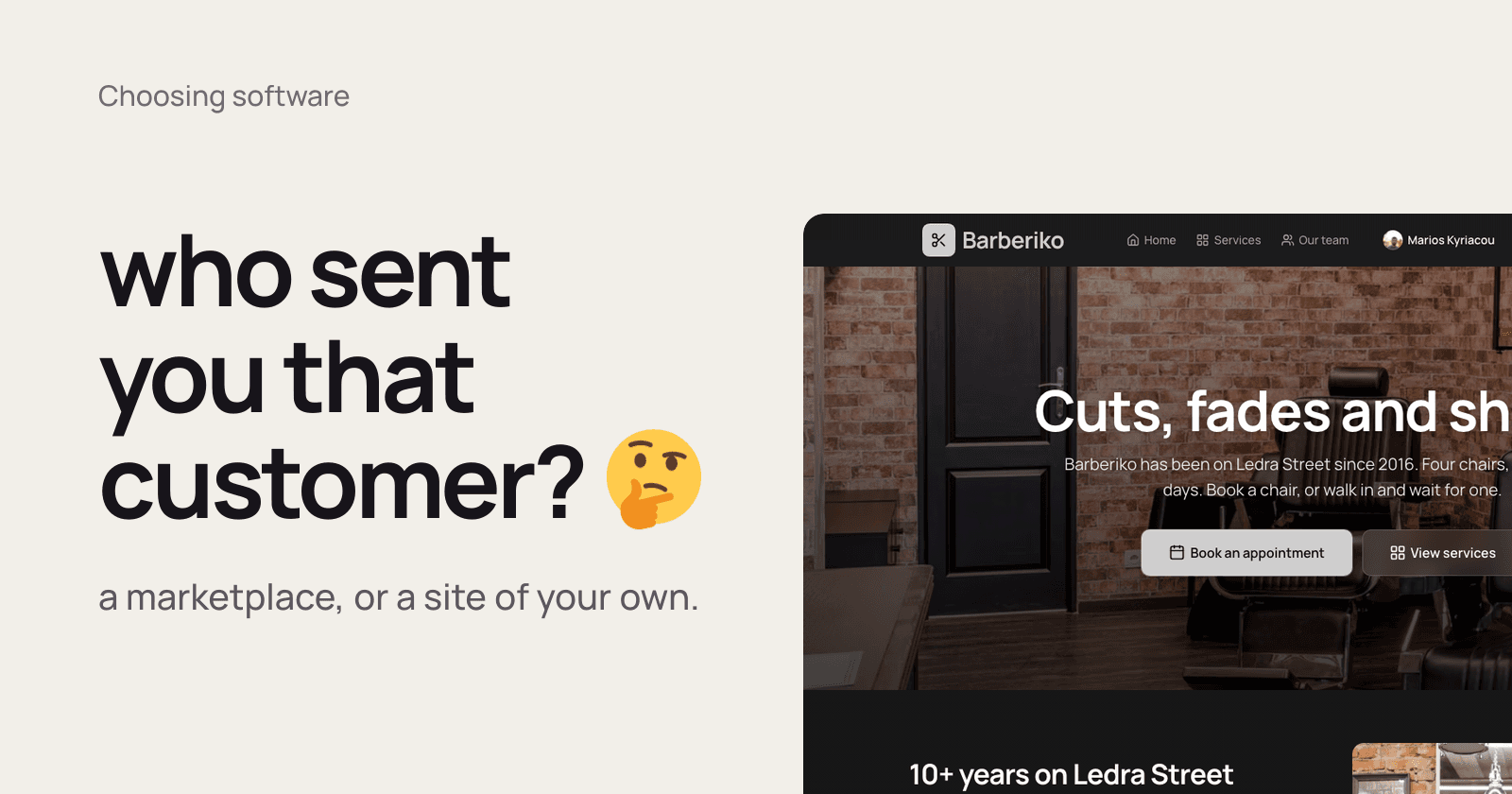
Rantevo is the other kind of product. There is no Rantevo app where strangers browse shops, and we will never send you a customer you had no way of reaching yourself. What you get is a website on your own address, with your services, prices, team and hours on it, where the people who already found you book themselves.
A barbershop's own website in a browser window, on its own address: its services and prices, its team and its opening hours, with a Book now button.
Since we send nobody, there's nothing to take a cut of. It's 0% commission on first-timers and regulars alike, and one flat price for the shop however many people work in it. The numbers, and the sum to do with them, are in what booking software costs.
Which one does your shop need?
Where do your new customers come from today? If the answer is Instagram, Google Maps, the sign outside and other people's recommendations, they are already finding you. What's missing is a way for them to book at eleven at night, and that's a site of your own.
If the answer is "they don't, yet", because the shop is new or the town is or Tuesdays are empty, a marketplace does a job for you that we can't. Paying for a customer you would never have met is a fair trade.
How many of you are there? A price for each bookable person and a flat price cross over somewhere. Do the sum with the team you have, then again with the team you want.
Whose address is on the link in your bio? A profile on somebody else's platform sits beside your competitors' profiles. A site of your own sits beside nothing.
What to ask before you pick
- Where do new customers find me now?
- How many of us take bookings?
- Who counts as a new customer?
- Whose address is on my link?
- Can I leave with my customer list?
Plenty of shops run both: a marketplace to be discovered, and their own site for everybody who comes back. If that's you, the line to read twice in any marketplace contract is how it decides who counts as new. It's the difference between paying once for a customer and paying again after a quiet year.
Ask them, not us
Don't take a vendor's word about other vendors. Everything above about Fresha and Treatwell is from their own pages, which are linked below with the day we read them.
We left every one of their numbers out on purpose. Prices change, they differ between Cyprus and Greece, and the only right figure is the one on their page today.
For the longer list of things to ask anybody, us included, there's how to choose booking software.
Where we read this
Everything this post says about another company comes from that company's own pages, linked here with the day we last checked them. We say how each one charges and never how much: their prices change, differ by country, and are theirs to state. If a page has changed since, believe the page.
- Treatwell: Partner page (Greece) — read on Sep 22, 2026
- Treatwell: Partner terms (Greece) — read on Sep 22, 2026
- Treatwell: Why Treatwell (Greece) — read on Sep 22, 2026
- Fresha: Marketplace — read on Sep 22, 2026
- Fresha: Pricing — read on Sep 22, 2026
- Fresha: Pricing (in Greek) — read on Sep 22, 2026
- Fresha: Partner Terms of Business — read on Sep 22, 2026