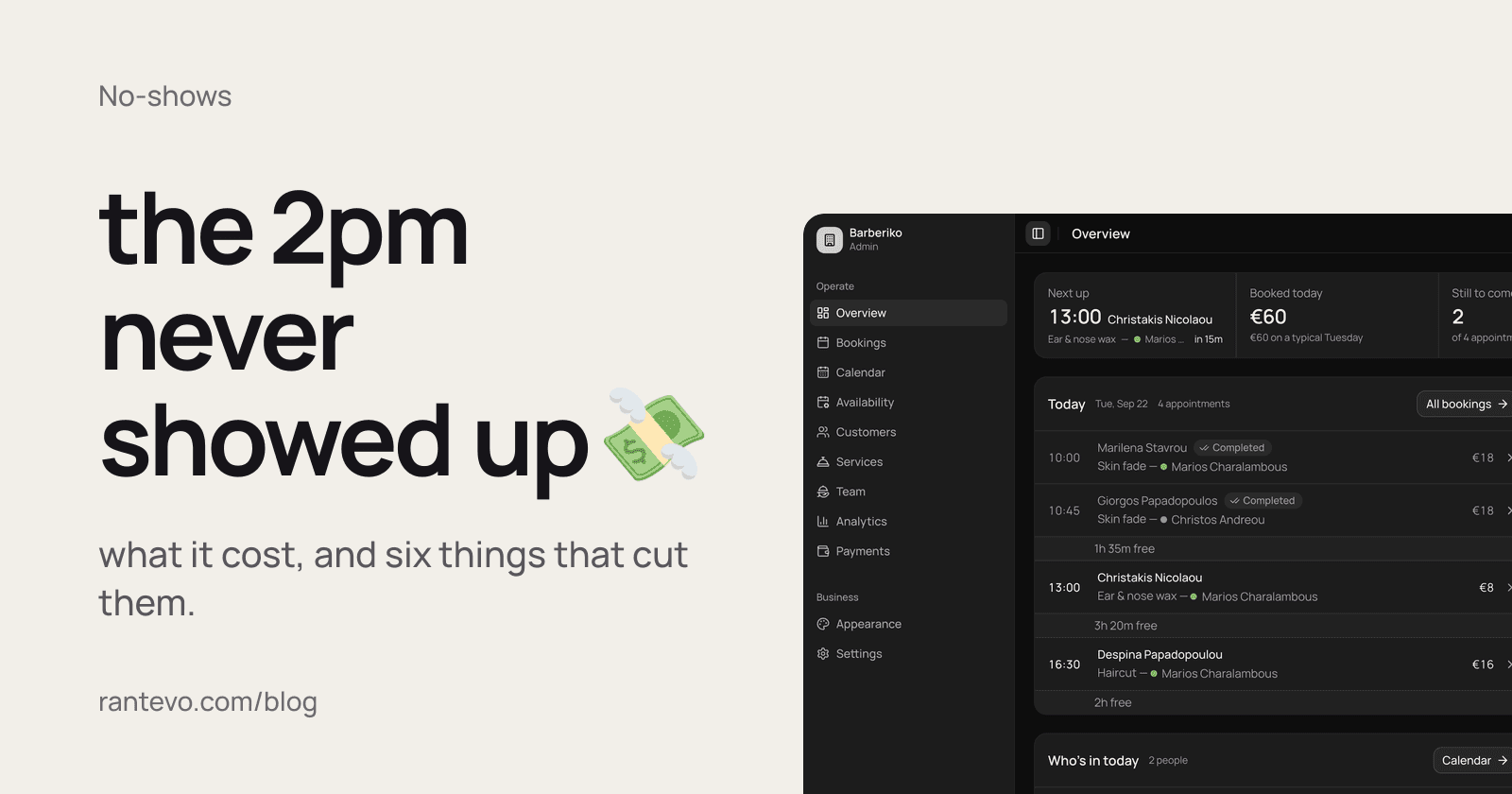
Two o'clock. The chair is empty, the cape is folded, and you're looking at the door. At ten past you stop looking. At half past you know.
Nobody rang. Nobody messaged. And the person who would have loved that slot found out you were full and went somewhere else.
What one no-show really costs
Less than you fear on the day, and a lot more than you think over a year.
Take a €20 haircut and one no-show a week. That's four empty chairs a month and €80 you didn't earn. Over a year it's €960, from a problem that feels like bad luck each time it happens.
One no-show a week, at €20 a cut
- 4empty chairs a month
- €80a month you didn't earn
- €960a year
Now do it with your own numbers. Count last month's no-shows, which is the hard part if you work from a paper diary, and multiply by your average price. If you do colour, or nails, or anything that runs past an hour, one a week is a great deal more than €960.
That number is what you can afford to spend fixing it.
Why people don't turn up
There are two kinds of no-show, and they need different fixes.
Two kinds of no-show
They forgot
- Booked three weeks ago
- Heard nothing since
- Would have come
They didn't care
- Booked three places
- Picked one on the day
- Lost nothing by it
The ones who forgot booked three weeks ago and haven't heard from you since. They're not bad customers. They meant to come. A reminder is what fixes these.
The ones who didn't care booked three places for Saturday and picked one in the morning. It cost them nothing, so they did it without thinking. A reminder does nothing here, because they hadn't forgotten. Only a deposit reaches them.
Most shops try to fix the second kind with the first kind's cure, get nowhere, and conclude that nothing works.
1. Remind them the day before
This is the cheapest fix there is.
A day before is the right distance. A week before and they've forgotten again. An hour before and it's too late for you to fill the slot if they cancel.
Send it by email and by text if you can. People who ignore one tend to read the other. And make it come from a system, not from you: a reminder you have to remember to send is a reminder that doesn't go out on the Saturday you're busiest.
On Rantevo this happens without you. Every customer gets an email the moment they book, and a reminder 24 hours before, by email and by SMS.
A reminder email for tomorrow's appointment, with the service, the time and who it is with, and the text message that goes with it.
2. Make cancelling easier than not turning up
This one sounds backwards.
A lot of no-shows are people who knew on Thursday that they couldn't make Saturday, and didn't tell you. Not out of malice. Ringing a shop to cancel is a small awkward job, and small awkward jobs get put off until it's too late to do them.
If cancelling is two taps on their phone, they cancel. And a cancellation on Thursday is a slot you can still sell.
So give them a way to cancel that doesn't involve talking to you. On Rantevo, a customer with an account on your site can cancel or move their own booking, up to 24 hours before unless you set a different limit. Later than that, the button isn't there and they have to get in touch.
3. Put the freed slot straight back on sale
A cancellation only helps if somebody else can take the time.
With a paper diary, a cancelled slot is a crossed-out line that nobody else knows about. With online booking, the moment somebody cancels, the time is back on your site for the next person who looks.
It's also the honest answer to "won't easy cancelling mean more cancellations?" A few more, yes. But each one turns a loss you can't recover into a slot you can sell.
4. Take a deposit where it hurts
For the second kind of no-show, nothing else works. Somebody who has paid €15 towards Saturday either comes, or cancels in time to get it back.
You don't need one on a ten-minute beard trim. You do on anything long, anything with a new customer, and the slots everyone wants. We wrote a whole post on how much to ask for and how to say it.
5. Say the rule where they book
A rule people only hear about when they've broken it feels like a punishment. The same rule, read before they booked, is just how your shop works.
Put it in plain words next to the button they press: how late they can cancel, and what happens to their deposit if they don't. Two sentences. No capital letters, no exclamation marks, no threats.
6. Keep a record, and act on the third time
Everybody misses an appointment once. The customer who has done it three times is a different matter, and you can only tell them apart if you've been writing it down.
Mark no-shows as no-shows, not as cancellations. On Rantevo that's one press on the booking, and it shows in that customer's history next to every other visit. Your analytics then tell you your no-show rate as a number, not as a feeling.
What you do with a repeat offender is up to you. The usual answer is that they book with a deposit or not at all.
What doesn't work
Overbooking. Airlines can do it because they have two hundred seats and a statistics department. You have one chair. The day both people turn up, you've let down a customer who did nothing wrong.
The angry message. It feels fair, and it loses you the customer along with the slot. If they forgot, they're embarrassed already. If they didn't care, your message won't change that.
A fine you can't collect. "No-shows will be charged in full" means nothing if you don't hold their card. It's a threat, everybody knows it, and it makes your booking page read like a warning sign. A deposit is the same idea, except it works.
The short version
Remind everyone the day before. Let people cancel without ringing you, and put the time straight back on sale. Take a deposit on the appointments you couldn't refill. Write the rule down where they book. Keep count.